Ecosia is a company I would love to work with. I haven't yet. So I treated this film as if the brief had landed on my desk.
That meant doing the whole job: understanding the client, choosing the problem worth solving, making the strategic and creative calls, and carrying the idea all the way to a finished film.
I had no internal data, no marketing targets and no audience research. Everything I built on is public: Ecosia's website, the way the brand talks on its social channels, and long-form interviews with its founder. Working without data forced a clear choice. Find the one problem that is visible from the outside, and that a single film can realistically move.

Research. Founder Mode: "Giving Up Hundreds of Millions, 250 Million Trees & The Fight Against Google" with Christian Kroll. The interview that shaped the concept.

Big tech owns the defaults. It even owns the verb.
Ecosia's biggest challenge is not its product. Its browser and search engine compete with giants whose software comes preinstalled on almost every device. They have shaped our language too: we don't search something, we google it.
No single film can solve that. But one consequence of it is something a film can address: too few people use Ecosia. Many have never heard of it. Many who have don't realise how little it takes to switch, or how much that switch changes.
That gap is where the intention at the top of this page comes from.

The real competitor. Not another search engine, but the default setting. One choice on this screen decides where every future search goes.

The film speaks to people who already want to do something good, and who probably feel anxious about where the world is heading.
Within that group I had one person especially in mind: the decision maker in their mid-40s who runs a company or a team. One switch from them can make Ecosia the default for an entire organisation. That is where a single viewer has the biggest impact.
If the audience is anxious, the film's first job is to calm them down. Not loud enthusiasm. A quiet sense that it's going to be okay. You don't have to take to the streets or turn your life upside down. You keep doing what you already do every day, and in the background you help change the world.
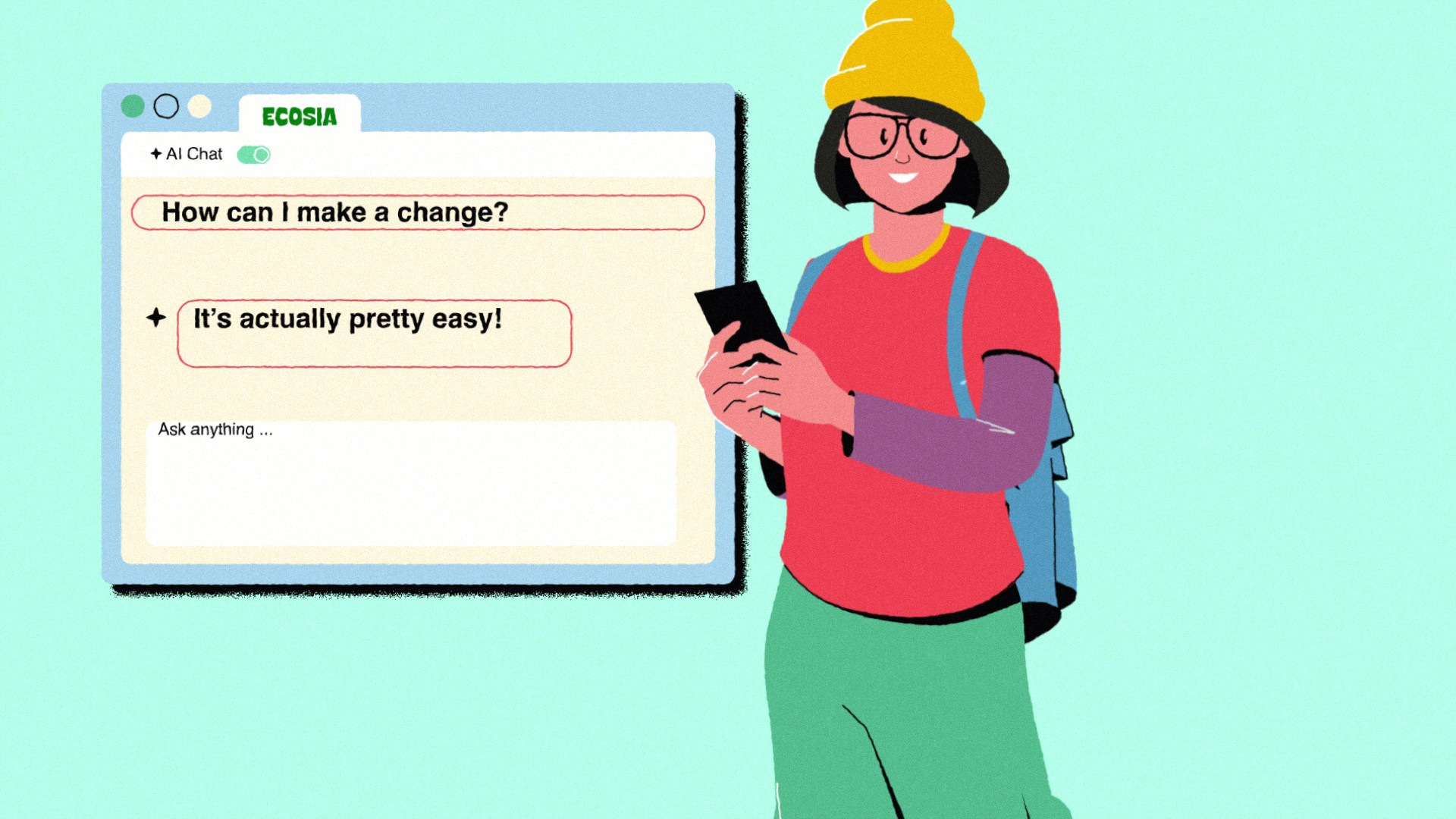
Module 1. The question that opens the film. The answer sets the tone for everything after it: it's actually pretty easy.

Simple on purpose. The film doesn't explain everything Ecosia does. It gives just enough to spark curiosity and the first step.

Anyone who wants the details can find them. The film's job is to start that journey.


The film is built from eight modules. Each one tells one part of the story, and each one works on its own.
That was a deliberate decision, made before a single frame was drawn. The result is one finished film plus a set of ready-made social assets that can be cut, recombined and reused for months.
It matters to me beyond this project. A lot of brand content today is made fast and forgotten fast. I believe in investing in one well-crafted piece and getting more out of it afterwards. A client who commissions one film gets a whole content library.


The floating browser tabs are the central visual idea of the film. They connect a digital product with the real world it affects.
Each tab is a small window onto something real: a tree, a forest, a farmer's field, healthy soil. The frame stays flat and graphic, like the interface on your screen. What happens inside it gets detail, texture and even real photography.
The tabs are also a production decision. Every tab is built as a separate asset, never baked into a scene. That turns a set of frames into a flexible design system.

Around the tabs, two more ideas set the tone.


Floating tabs. Flat, graphic frames around a detailed world, even real photography.

The tab library. Extra assets beyond the film's scenes, ready to use as decorative elements or as the starting point for future deep-dive videos.


Every frame started on paper. Sketching first let me test the cast, the compositions and the level of detail before anything went into colour.
The characters had to feel like real people the audience could see themselves in: a young woman with her phone, a farmer, a man explaining the technology. I explored a wider cast before narrowing it down to three, and kept proportions natural so the stylised palette could do the simplifying.


The cast. The young woman, the farmer and the man with the tablet, with pose and costume variations.

Explorations. Characters I developed but left out, to keep the story focused on three faces.


One tree, every story. An early composition that gathers all the topics around a single tree. In the film, each one gets its own module.


Control room and logo. From line drawing to final frame.

Wetland. Rough to clean line. The final version lives inside a browser tab in the farmers module.

This is spec work, so there are no campaign results to report. What it shows is a way of working.
Read the client's situation. Pick the problem a film can actually solve. Define who it's for and what they should feel. Then build every decision around that: structure, style, craft and deliverables.
That is the role I want to play for brands. Not only making something look good, but helping values-driven companies turn what they stand for into work that makes people act.